Affiliate linksSome links pay us — we explain who, why, and when on our About page.
Best AI Tools for Lead Generation in 2026
We dug through pricing pages, G2 reviews and named publications to find the AI lead generation tools actually worth paying for in 2026 — with UK pricing.
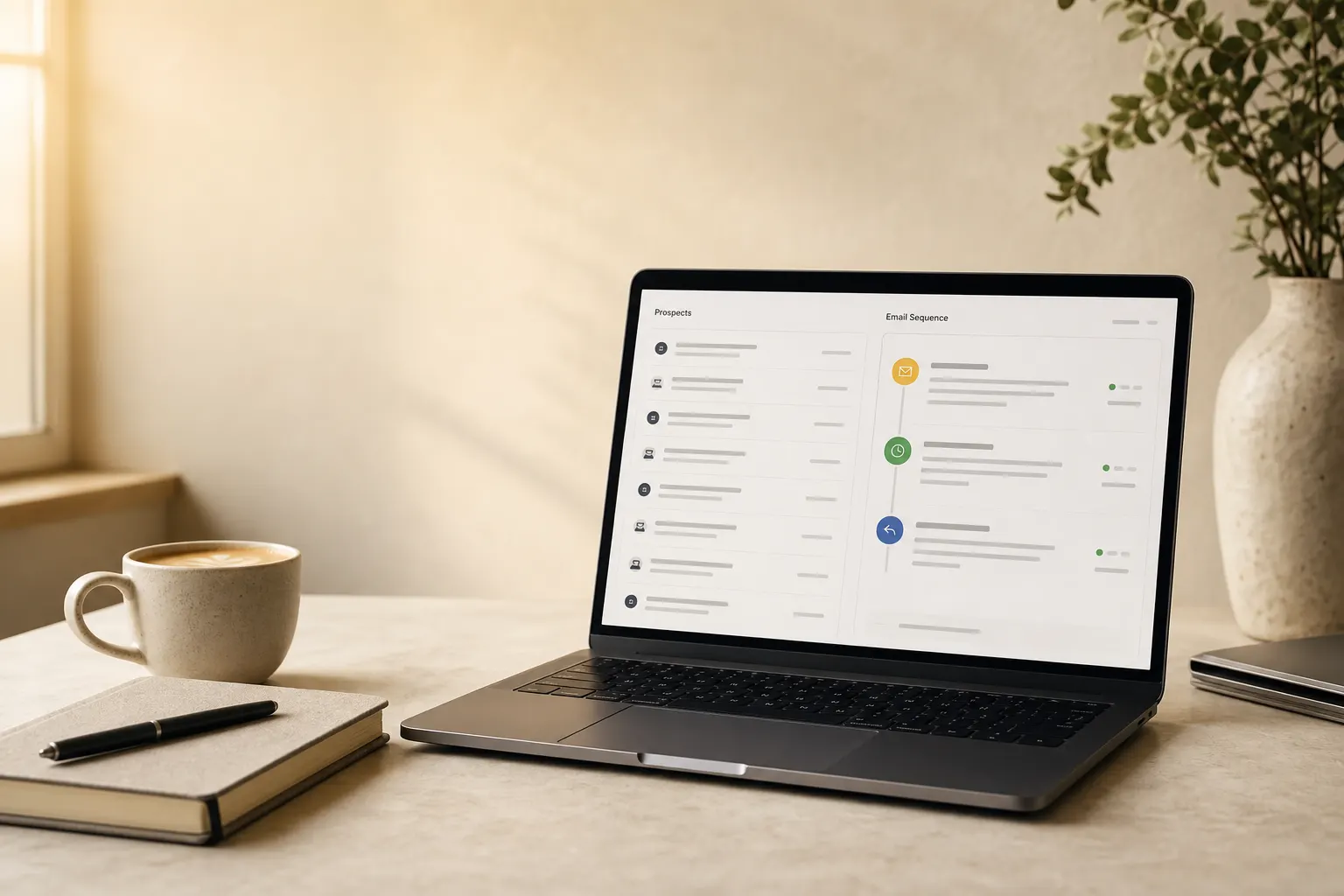
After two weeks of reading pricing pages, G2 review pile-ons and Reddit threads written by people who clearly hadn't slept, we've landed somewhere unfashionable: there is a best AI lead generation tool for most UK solopreneurs and small teams, and it costs about the same as a Pret lunch habit.
The verdict
Apollo.io pricing in 2026 starts at $0/mo for a free plan and scales to $119/user/month for the Organization tier, with all paid plans using per-seat pricing. At roughly £39/user/month for the Basic tier (annual billing, around $49 USD), it's the only tool on this list that gives a one-person shop a real database, sequencing and CRM sync without a discovery call.
If you're selling into the UK or wider EMEA and you live on the phone, the answer is different: Cognism, even though it'll cost you something north of £11,850/year (~$15,000 starting). And if you want to chain together waterfall enrichment across dozens of providers and you've got someone technical, Clay at £146/month (~$185 Launch) is the obvious pick.
apollo-io
Free tier is genuinely useful, paid plans start at ~£39/user/month, and you get 275M+ contacts plus sequencing in one dashboard.
cognism
Diamond Data phone-verified mobiles plus DNC screening across 15+ countries. Pricey but the GDPR story is the cleanest in the category.
clay
Waterfall enrichment across 150+ providers, unlimited seats, and a March 2026 pricing reset that dropped data costs 50–90%.
Who should pick something else
If you're a B2B marketer running ABM at enterprise scale, none of our top three is the right home — 6sense or ZoomInfo make more sense. 6sense was recognized as a Leader in the Forrester Wave for B2B Revenue Marketing Platforms, Q1 2026, and they price accordingly. If you're a freelancer who just wants three good warm intros a month, save the £39 and use LinkedIn manually for one more quarter. We're not above admitting that.
Pricing at a glance
| Product | Entry price (GBP, approx) | Key limit |
|---|---|---|
| Apollo.io Basic | ~£39/user/mo (annual) | 5,000 data credits/year, no AI features |
| Apollo.io Professional | ~£62/user/mo (annual) | 10,000 data credits/year, AI email writing |
| Clay Launch | ~£146/mo | 2,500 Data Credits + 15,000 Actions/mo |
| Clay Growth | ~£391/mo | 6,000 Data Credits, CRM sync, HTTP API |
| Cognism Standard | ~£11,850/yr starting | Annual contract only, 5 seats included |
| Lemlist (lead finder + sending) | ~£24/mo + ~£24/mo | Email-only, separate sending plan |
| Instantly lead finder | ~£24/mo | Email-only, smaller database |
| LeadIQ paid | ~£28/user/mo | Needs LinkedIn Sales Navigator for full value |
GBP figures are approximate conversions from USD list prices at mid-2026 rates. All vendors price in USD, so your card will move slightly with the exchange rate.
---
1. Apollo.io — best overall for solopreneurs and small teams
Apollo has become the default first answer for anyone asking "where do I get B2B leads?" on r/sales, and the numbers explain why. Apollo.io has become one of the most popular sales intelligence platforms on the market, with over 210 million contacts in its database and pricing that starts at free — though the database contains 275M+ contacts per SyncGTM's 2026 review, depending on whose count you trust.
What reviewers say. Many G2 users highlight that Apollo.io consolidates prospecting, email sequencing, dialers, and CRM functionality into one platform at a fraction of what separate tools would cost, with several reviewers citing 60% or greater tech stack savings. The free tier in particular gets praise — the free plan offers unlimited email credits, 5 mobile credits, 10 export credits monthly, basic sequence automation capped at 2 sequences, and G2 reviewers note it is genuinely useful for early-stage founders and solo users but becomes limiting quickly.
What real users grumble about. Pricing rage is the running theme. One G2 reviewer cited by the same write-up put it bluntly: "I really dislike their predatory pricing. The fact that credits don't roll over and they charge extra in subsequent months if you don't change your plan is super annoying. Plus, there are no refunds. We're considering switching because of these pricing extortion policies." Salesmotion's analysis is equally direct: Apollo.io pricing ranges from free to $119/user/month (annual billing), but credit-based limits, feature gates, and data accuracy gaps mean actual costs often run 2-3x the advertised rate, and teams doing heavy outbound or cold calling should budget $150-$400/user/month once credit overages and add-ons are factored in.
Pricing in the real world. Basic is $49/user/mo annual with 5,000 data credits/year; Professional is $79/user/mo with 10,000 credits and AI-assisted email writing; Organization is $119/user/mo with 15,000 credits and 200 mobile credits/month. That maps to roughly £39 / £62 / £94 per user per month in sterling. Monthly billing adds about 17%. SyncGTM's testing found Apollo.io data accuracy averages 65% overall — in the US, contact details match at 80–88%, but outside the US, accuracy drops to 60–73% depending on the region, which is the number to keep in mind if you're prospecting into Europe.
Who it's for. Solopreneurs and teams under five people running US-heavy outbound who want one bill instead of four. The honest UK caveat: pair it with a separate verification tool if you're emailing into Europe — bounce rates of 15–25% on Apollo-sourced contacts will torch a fresh sending domain inside a month.
Our verdict: The best free-to-£39 starting point in the category, provided you treat Apollo as the data layer and accept that exporting into a proper sender (Instantly, Smartlead) is a near-mandatory upgrade.
The positives:
- Free tier is genuinely usable, not a five-minute toy.
- 275M+ contact database with unlimited email credits on most paid tiers.
- One dashboard for prospecting, sequencing and (from Pro) a dialer with call recording.
- Annual billing saves ~17–20% versus monthly.
- Native CRM sync with HubSpot and Salesforce from Basic upwards.
---
2. Clay — best for technical operators and agencies
Clay is the tool every B2B GTM person on LinkedIn won't shut up about, and it's the one with the most dramatic price story of 2026. Clay announced its pricing change on March 11, 2026, with the new structure taking effect immediately for new customers while existing customers were grandfathered on their old plans indefinitely.
What changed. Three self-serve plans collapsed into two (Launch at $185, Growth at $495), billing split into Data Credits and Actions, HTTP API requests were reclassified from complimentary to Action-consuming, and marketplace data prices dropped 50 to 90 percent. Translated into sterling: Launch is roughly £146/month, Growth roughly £391/month.
What reviewers say. Gumloop's roundup — written by someone who admits to using the tool themselves — keeps coming back to one feature: waterfall data enrichment, which is what has made Clay a popular choice, especially for large enterprise companies. The platform helps you chain together multiple providers of data — scrape LinkedIn, get Clearbit, and access multiple database data — so you can get accurate data when creating prospecting lists and not have gaps or outdated data. Cleanlist's March 2026 analysis is more pointed about who it's actually for: Clay's strength is not enrichment — it is orchestration. The $495/month Growth plan makes sense for teams building complex, multi-step workflows that combine data enrichment with AI research, personalized outreach, and CRM automation in a single table. If you are replacing 3-4 separate tools, Clay's total cost can be competitive.
The real-user grumble. Clay is hard. A Warmly write-up quotes a G2 reviewer saying "It's not the easiest tool to use, to be fair. Over the months they've evolved but at least in my memory when I started it took me weeks to understand what's what." Cleanlist puts the same point in procurement terms: variable data credit costs make budgeting unpredictable, and the platform has a steep learning curve — building and maintaining Clay tables requires technical capacity that not every sales team has.
Pricing gotchas. When you exhaust monthly Data Credits mid-cycle, Clay offers top-ups at roughly a 30% premium over your plan's per-credit rate (down from 50% before the March 2026 change, but still a real surcharge). Worth knowing: one welcome change from the old model is that failed lookups no longer consume credits — under the pre-2026 system, Clay charged for provider queries that returned nothing, and high-volume teams could burn 20-30% of their credits on empty lookups.
Who it's for. Agencies, RevOps people, and the one freelancer in your network who has "GTM engineer" in their bio. If you can't already say what a webhook is without Googling, Apollo is a better first stop.
Our verdict: The most flexible enrichment platform on the market, but it's a tool for builders. The £146/month Launch tier is fine for testing; serious use lives on £391/month Growth with CRM sync and the HTTP API turned on.
The positives:
- 150+ data providers chained in waterfall logic from one table.
- Unlimited user seats on every paid plan — no per-seat tax.
- Free tier with 100 Data Credits, enough to validate before you pay.
- Failed lookups no longer burn credits (post-March 2026).
- Genuine cost win for teams replacing three or four separate tools.
---
3. Cognism — best for UK and EMEA cold calling
If you're reading this from a desk in Manchester or Bristol, this is probably the most relevant section. Cognism is the only tool in the category that was clearly built for the way UK B2B actually works.
What reviewers say. Founded in 2015, the company has grown rapidly — particularly in the UK and European markets — by focusing on two key differentiators: Diamond Data, phone-verified mobile numbers with claimed 98% accuracy, and GDPR-first compliance with DNC list screening across 15+ countries. SyncGTM's 2026 review is direct about who should pay for it: Cognism is a GDPR-compliant B2B data provider with phone-verified mobile numbers that deliver 2-3x higher connect rates for European contacts. It is the best option for cold calling teams selling into the UK