Affiliate linksSome links pay us — we explain who, why, and when on our About page.
Make vs Zapier: Which Automation Platform Wins for UK Solopreneurs in 2026?
We compare Make and Zapier on price (in £), real reviewer consensus, and where each one actually breaks. The winner depends on whether you'd rather count credits or hand over a card.
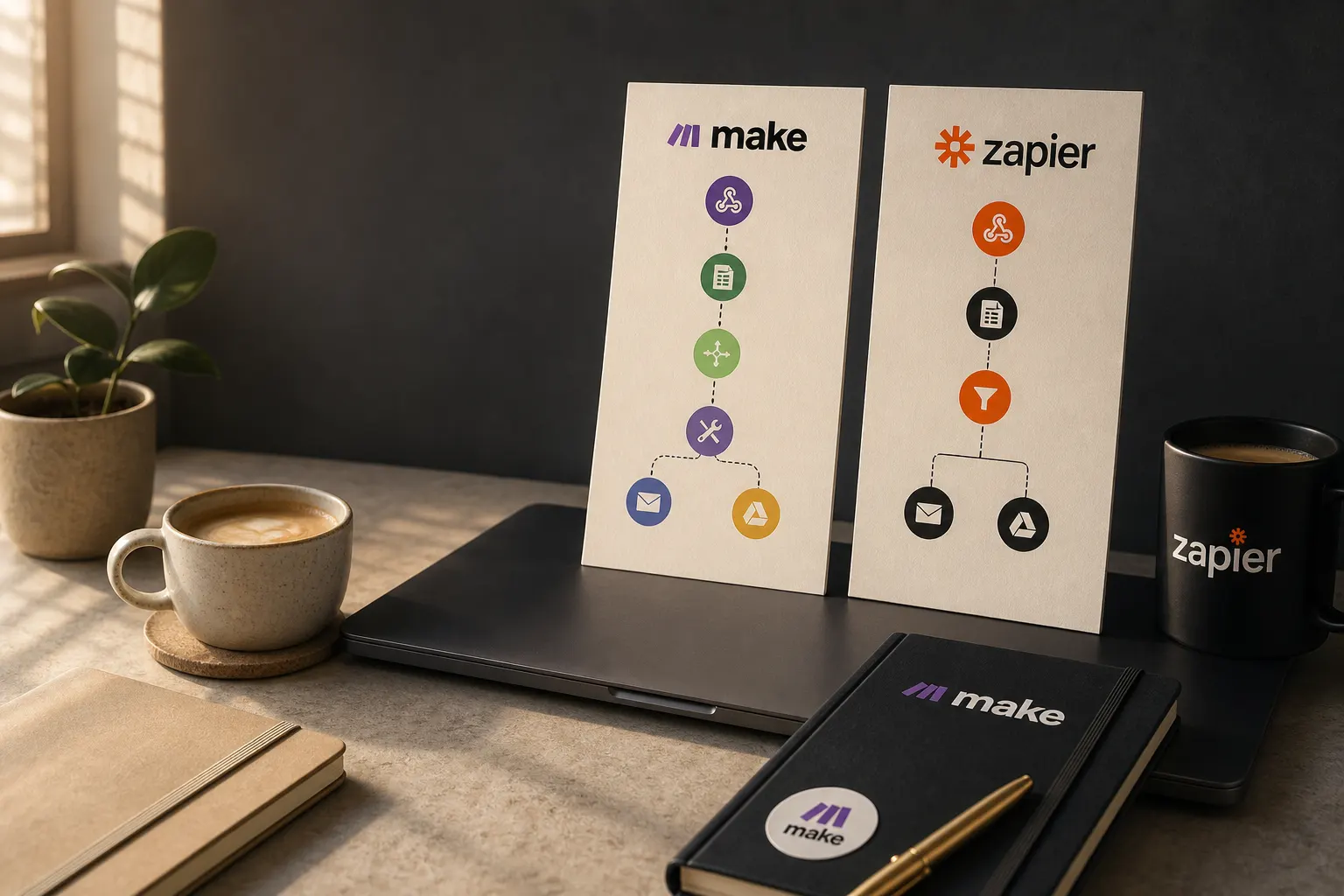
If you're a UK solopreneur trying to decide between Make and Zapier in 2026, the answer is almost embarrassingly clear on price — and almost equally clear on ease of use, just pointing the other way.
Our verdict: Make wins for value-conscious operators. At roughly £7/month (USD $9) for 10,000 credits on the Core plan, Make is the platform we'd put our own money on for any solo business running real workflow volume. At $29.99/month for 750 tasks, Zapier works out to roughly $0.04 per task, while Make charges around $0.001 per operation — a 40x price difference per unit of automation, even before you factor in that Zapier tasks and Make operations aren't quite apples-to-apples.
Who should pick Zapier instead: non-technical users who genuinely cannot face a visual canvas, anyone whose stack depends on a niche app only Zapier supports (it has over 9,000 integrations versus Make's 3,000+), and small teams who'd rather pay a premium than think about credit budgets at 11pm on a Sunday.
Make
Roughly £7/month for 10,000 credits on Core — 3–5x cheaper than Zapier at equivalent volume, with a proper visual builder.
Zapier
Around £16/month (annual) for Professional. More expensive, but the gentlest learning curve in the category and 9,000+ app integrations.
Pricing at a glance
Both vendors price in USD. We've converted at roughly £0.79 to the dollar — your card statement will vary slightly, and Make's own page confirms prices are cheaper with annual payment in advance compared to monthly payments.
| Product | Entry paid plan (GBP, annual) | Key limit |
|---|---|---|
| Make Core | ~£7/mo ($9) | 10,000 credits/month, unlimited active scenarios, 1-min interval |
| Make Pro | ~£13/mo ($16) | 10,000 credits, priority execution, custom variables |
| Make Teams | ~£23/mo ($29) | Team roles, shared templates |
| Zapier Free | £0 | 100 tasks/month, 2-step Zaps only |
| Zapier Professional | ~£16/mo ($19.99) | 750 tasks/month, multi-step Zaps, premium apps |
| Zapier Team | ~£55/mo ($69) | 2,000 tasks/month, shared workspaces |
A note before we go further: Make changed its billing unit from "operations" to "credits" last year. Make switched from "operations" to "credits" in August 2025. For standard automations, 1 credit = 1 operation (same cost). For AI features, credit consumption varies by token usage. If you're not running heavy AI steps, you can read "credit" as "operation" and your invoice will look much the same.
---
Make
The cost case for Make is almost too easy to make. Zapier's own blog — hardly a hostile witness — concedes the basics: Make offers a free plan with 1,000 credits per month, enough to try the product and run a few light automations. Paid plans start at $12/month (billed annually) for 10,000 credits (Core) and scale up with higher credit packs and extra features like priority execution, team roles, and enterprise security. (Make's own pricing page actually shows Core at $9/month annual; the $12 figure appears to include a recent uplift or monthly billing — either way, it's a fraction of Zapier's equivalent tier.)
Independent reviewers confirm the gap. PxlPeak's 2026 breakdown puts it bluntly: Make is 3-5x cheaper than Zapier for equivalent workflows. But 'operations' aren't 'tasks' and the free plan has a catch. That caveat matters — Make counts "operations" differently than Zapier counts "tasks." A single Zapier task might equal 3-8 Make operations. The actual savings are real but smaller than the headline numbers suggest. Adjusted for that, Make is still meaningfully cheaper at every realistic volume.
The real-user picture, though, includes a recurring warning: credits evaporate faster than expected when workflows are badly architected. Thinkpeak's analysis flags polling as the prime offender — Scenario: Watch Google Drive for new client assets. Schedule: Every 5 minutes. Math: 12 checks per hour × 24 hours = 288 credits per day. Monthly Cost: 288 × 30 = 8,640 credits/month. The Result: You have burned nearly 90% of your Core Plan just checking a folder that might only receive files once a week. Switch the trigger to a webhook and the cost disappears. This is the kind of thing nobody warns you about until your scenarios stop at 3am.
There's also a watch-out on data volume. Each pricing tier has a Data Transfer limit. The Free plan offers 100 MB/month, while the Core plan offers 1 GB/month. If you automate video content, you will hit that 1GB limit instantly. If you're moving anything bigger than text and JSON, route the URL, not the file.
UK users on Reddit lean technical-first when discussing Make: "I've used Zapier for a while now and it's been solid...until it wasn't. As my workflows got more complex, I started hitting limits—both in terms of pricing and how messy things got with too many zaps stacked on top of each other." That migration pattern — Zapier first, Make later — comes up again and again.
Who it's for: UK solopreneurs and small agencies running 5–15 active scenarios, anyone comfortable spending an afternoon learning a visual canvas, and anyone whose accountant has started raising eyebrows at the Zapier line item.
Our verdict: The default choice for value, provided you're willing to spend half a Saturday reading credit-consumption guides before you commit.
The positives:
- Core plan at roughly £7/month for 10,000 credits — best price-to-volume in hosted automation
- Visual canvas with routers, iterators and filters that handle genuinely complex logic
- Each module action in your scenario, like adding a Google Sheet row or fetching Gmail account data, counts as one credit — billing is at least conceptually transparent
- Free tier (1,000 credits/month, 2 active scenarios) is usable for testing before you pay anything
- As of November 6, 2025, all paid plan users can connect directly to their own AI provider — OpenAI, Anthropic, or any other — using their own API key, billed at standard credit rates
---
Zapier
Zapier's pitch hasn't really changed: it's the easiest way to connect two apps, full stop. Zapier offers integrations for more than 9,000 apps and helps you easily move data between them to automate repetitive tasks. Nothing else in the category comes close on integration breadth, and the gap matters more than it sounds — if your stack includes a slightly obscure UK accounting tool or a vertical CRM, Zapier probably has a native connector and Make probably doesn't.
The reviewer consensus on usability also clearly favours Zapier. Softr's comparison cites a representative Reddit view: "I prefer Zapier over Make because it's more no-code friendly and a better UX in general, which matters. It means you can learn it quicker and if you struggle, it's got stronger support and community." The same user noted a genuinely useful detail — "I love that their Formatter actions are free. I use them loads and they're really versatile. I might have a zap with 10 actions and only two or three are actually paid." Zapier's filter and formatter steps don't burn tasks, which softens the per-task cost somewhat.
But — and it's the kind of "but" that ends contracts — the pricing has gone in one direction. PxlPeak doesn't pull punches: Zapier raised prices again. The free plan now caps at 100 tasks. Professional starts at $29.99/month for 750 tasks. Annual billing brings that down to $29.99/month (billed monthly) or $19.99/month (billed annually) and includes 750 tasks per month, multi-step Zaps, premium app access, and faster 15-minute updates — so roughly £16/month if you commit for the year.
The jump to the Team tier is where the wheels can come off a small business budget. The jump from Professional ($29.99 for 750 tasks) to Team ($103.50 for 2,000 tasks) is brutal. You are paying 3.4x more for 2.7x more tasks. That's around £82/month for what most growing solopreneurs would consider a normal workload — and it explains the steady migration to Make that reviewers keep noting.
User sentiment on G2 is mixed and includes a complaint that lands in our inbox monthly: "Many of the features of the platform have fallen behind rivals, pricing has gone through the roof, and their practices around annual billing are dishonest". Caveat that as one review among many — but it captures the mood of long-term Zapier customers in 2026.
The unified subscription is genuinely useful, though. The unified plan structure bundles Zaps (workflows), Tables (data storage), Interfaces (custom forms/apps), and Zapier MCP (AI tool connections) into single subscriptions—a significant shift from previous separate pricing for each component. You're getting more in the box than you were eighteen months ago.
Who it's for: non-technical founders, anyone with workflows under 750 tasks/month that aren't growing fast, and operators who'd rather pay a premium than learn a second visual builder. If "I just need it to work" is the brief, Zapier is still the safer pick.
Our verdict: The right answer if usability and integration breadth genuinely matter more to you than money. For most UK solopreneurs paying out of pocket, they don't.
The positives:
- 9,000+ app integrations — the broadest catalogue in the category by a clear margin
- Genuinely beginner-friendly interface; Zapier is designed to be simple. You don't need technical knowledge to get started. The interface is straightforward, and you can set up most automations in minutes
- Filters and Formatter steps don't count as tasks, which softens the per-task price in practice
- Unified plan bundles Zaps, Tables, Interfaces and Zapier MCP — more useful than the previous component-by-component pricing
- When you reach your plan's task limit, we'll notify you via email. When you reach your plan's task limit, we'll also switch you to pay-per-task billing — your automations don't simply die overnight
---
Didn't make the shortlist, and why
n8n (self-hosted): Cheaper than both at high volume, but you're now running infrastructure. If you can deploy a VPS and don't mind the ops work, it's worth a look — but it's a different product category for a different buyer. We'd only recommend it to operators who already self-host other tooling.
Lindy, Activepieces, Arahi AI: All three turned up repeatedly in our research, and all three are positioning hard as Zapier replacements. None has the install base, integration depth, or track record we need to recommend over Make or Zapier yet. Worth revisiting in 12 months.
Workato, Tray.io: Enterprise-tier integration platforms with enterprise-tier pricing (Tray's starter plans around $38,211/year). If you're a solopreneur and someone's pitched you these, politely decline and go back to Make.
---
The honest bottom line
We've spent the equivalent of a small mortgage payment on Zapier subscriptions over the years, and we'll admit the muscle memory is hard to break. But the maths in 2026 doesn't support the loyalty. Unless you genuinely cannot face a visual canvas or you absolutely need a connector only Zapier has, Make's Core plan at roughly £7/month is where we'd put a new automation budget today.
Start on Make's free tier, build one real scenario, watch your credit consumption for a week, then commit to Core annual if the numbers work. That's the playbook — and it's the same one we'd give a friend asking over a pint, which is usually how these decisions actually get made.
Related tools
Make
Automation
Make is a visual automation builder for connecting apps, routing data, and building multi-step workflows.
View profileZapier
Automation
Zapier connects web apps through automated workflows and simple trigger-action logic.
View profile